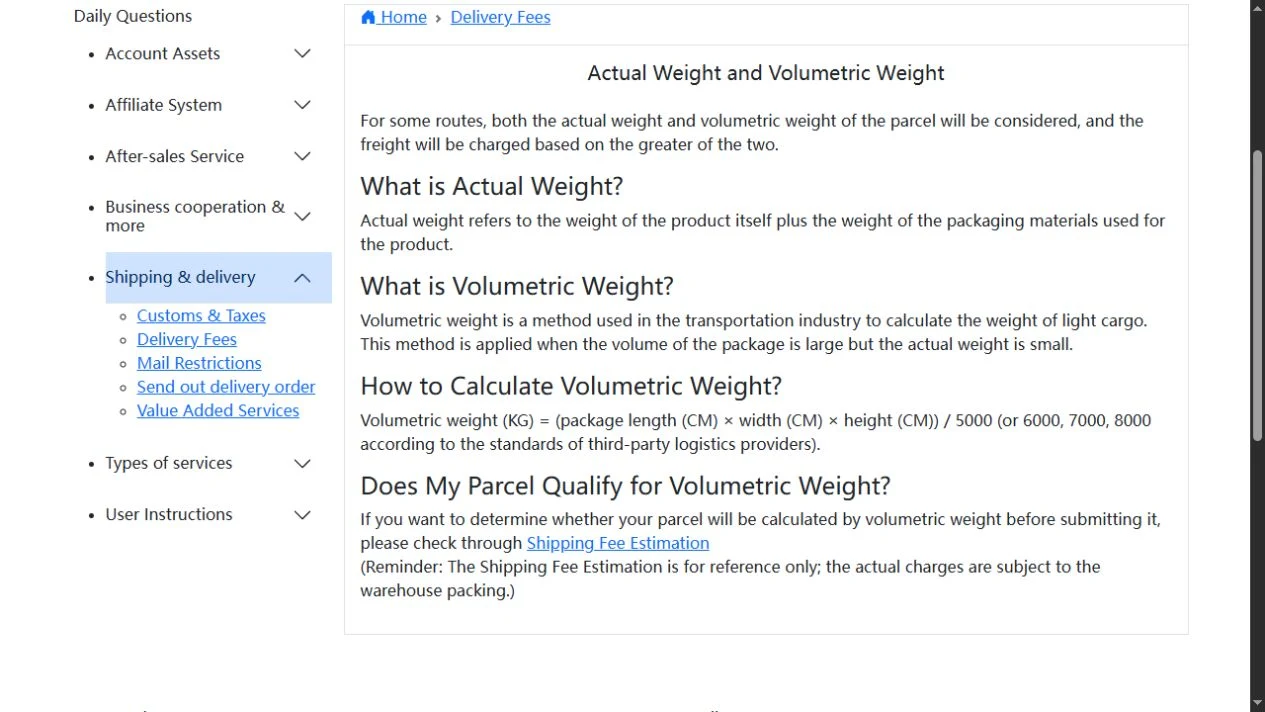
A Joyagoo shipping calculator is useful when its inputs describe the package you are considering. Entering product prices does not determine international freight. You need destination, contents, packed dimensions, actual weight and the selected service's rules.
Work through one illustrative package
The following values are hypothetical and are not a shipping quotation:
| Input | Example |
|---|---|
| Packed dimensions | 48 × 35 × 25 cm |
| Assumed volumetric divisor | 6000 |
| Actual packed weight | 6.4 kg |
| Volumetric result | 48 × 35 × 25 ÷ 6000 = 7 kg |
For a line that compares these weights and uses the larger, the starting basis would be 7 kg. The line's rounding, minimums and other terms still need to be applied. Divisor 6000 is an assumption in this example, not the rule for every provider.
Test a packing change carefully
If this illustrative box becomes 22 cm high, its volumetric weight becomes 6.16 kg. With actual weight unchanged at 6.4 kg, actual weight would become the larger value. Further reducing volume would not automatically reduce that greater-of basis below 6.4 kg.
This does not promise savings. Real packing can change actual weight and protection too, and the final payable amount depends on the service. Compare the actual outcome rather than only the smaller dimension.
Add the information the formula cannot supply
The weight calculation does not confirm route eligibility, a delivery date or a live rate. Check the service for the actual contents and address, then read what its quote includes. Keep product charges separate from freight.
Browse accessories in the catalog without assuming that a small-looking object needs little protective space. The packed item is the relevant input.
Shipping guidance explains equal-input comparisons. Settle QC questions and eligible returns before finalising contents. The buying guide shows where an early estimate becomes a decision about a real parcel.